
Your Google Business Profile Isn't Your Business: What New Google Maps Research Means for Local Visibility
For years, local SEO has revolved around a familiar checklist: optimize your Google Business Profile, choose the right categories, keep your hours accurate, earn reviews, add photos and make sure your business information is consistent across the web.
Those things still matter.
But new research into the architecture behind Google Maps suggests that they are only the visible surface of a much larger system — and that the businesses best positioned for the next era of local search may be the ones Google can understand most completely, not simply the ones with the best-optimized listing.
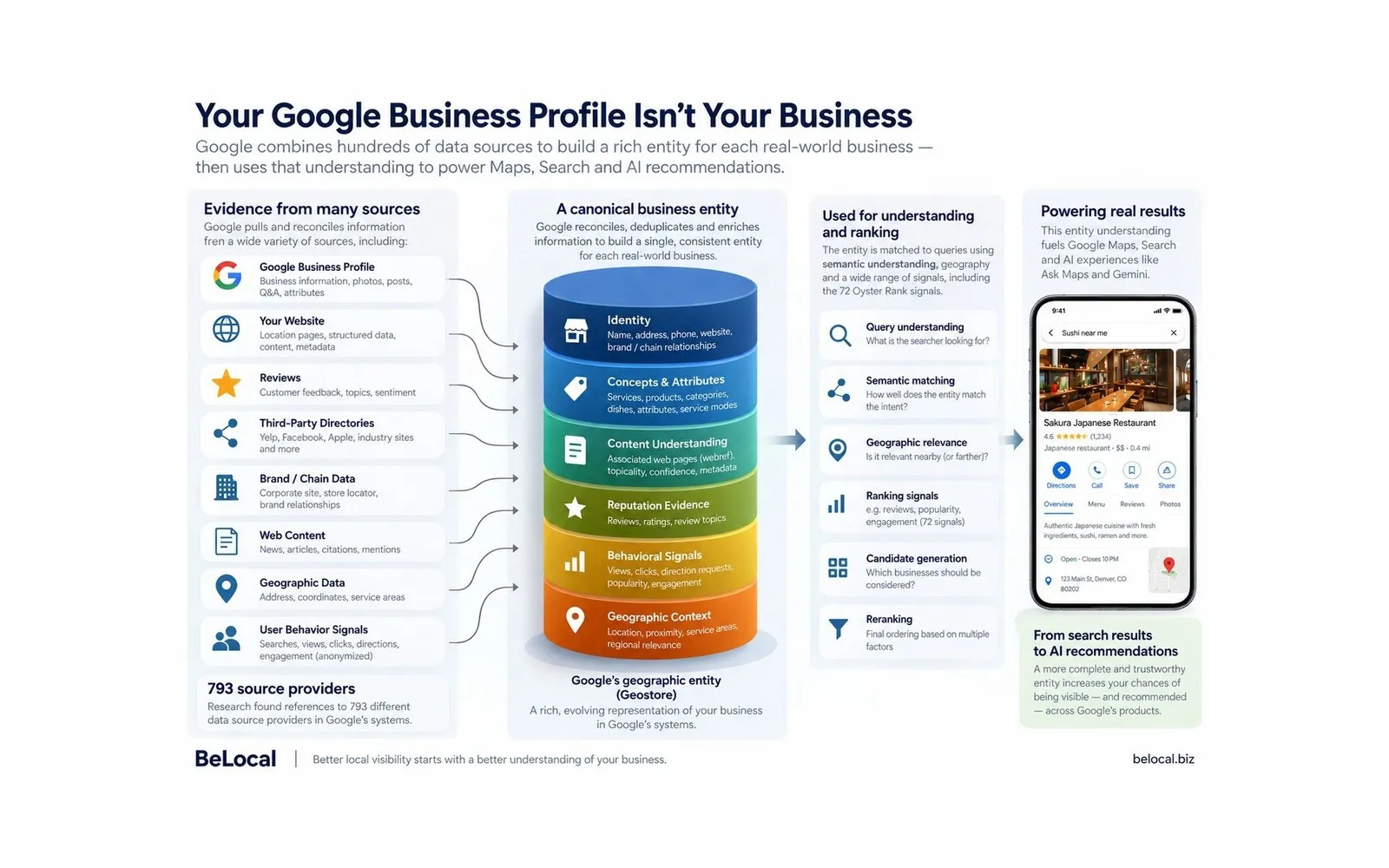
Research recently published by Search Engine Land examined recovered data from Geostore, the system Google uses to represent geographic entities. Among the findings were 72 ranking signals, 793 data source providers and hundreds of local-search intent types.
The most important finding, however, may be much simpler:
Your Google Business Profile listing is not the same thing as Google’s understanding of your business.
The listing is the interface. The entity is underneath it.
When you look at a business in Google Maps, you see a listing: its name, address, category, reviews, photos, hours, website and other familiar information.
Behind that listing, Google maintains something much richer.
The research describes a canonical geographic entity that can contain information about the business’s identity, location, website, brand or chain relationships, Knowledge Graph connections, concepts and ranking information.
And Google doesn’t necessarily build that entity from one source.
The recovered system references 793 source providers, along with mechanisms for determining provenance, trust and how conflicting information should be reconciled.
That helps explain a frustrating experience many businesses have encountered: you correct something in Google Business Profile, only to see the old information return.
From Google’s perspective, your edit may not simply replace the old value. It becomes another piece of evidence in a system that may contain conflicting information from other sources.
For marketers, that changes the question.
Instead of asking only:
“Is our Google Business Profile correct?”
We should also be asking:
“What does Google believe about this business, and how strong and consistent is the evidence supporting that belief?”
Your website isn’t separate from your local presence
Another important finding is how closely Google’s web index and its geographic entities appear to be connected.
The researchers identified a system called “webref” that associates web documents with entities while storing information such as topicality, confidence and geographic metadata.
That gives location pages and store locators a much bigger job than simply ranking for searches like “dentist in Tampa” or “coffee shop in Orlando.”
A well-built location page can help Google establish which real-world entity a page describes, what that entity offers, where it exists and how confidently the information on the page should be associated with it.
In other words, your website isn’t merely competing alongside your Google Business Profile.
It can provide evidence about the business behind the profile.
This is especially important for multi-location brands. Every individual location needs a clear, consistent digital identity that connects back to the larger brand while accurately describing what is true about that specific location.
Google understands concepts, not just categories
Local marketers spend a lot of time thinking about Google Business Profile categories.
Google appears to think much more broadly.
The recovered architecture includes a conceptual system capable of representing businesses, products, services, dishes, cuisines, attributes, service modes, review topics and other characteristics.
Consider a restaurant.
Knowing that its primary category is “Japanese restaurant” is useful. But answering a modern local search might require Google to understand much more:
- Does it serve ramen?
- Does it have vegetarian options?
- Is it good for groups?
- Do recent customers mention long waits?
- Is it open tonight?
- Do reviewers consistently praise its service?
- Is it close enough to the person asking?
That distinction becomes especially important as local search becomes conversational.
Someone may no longer search only for “Japanese restaurant near me.” They can ask Google for a restaurant suitable for six people near their hotel, with vegetarian choices, good recent service reviews and little expected waiting time.
To answer that question well, Google needs more than a category and a star rating.
It needs a rich representation of the place.
Reviews are also evidence about what your business is
This changes how businesses should think about reviews, too.
Review strategy has traditionally focused on quantity, rating and recency. All three remain useful.
But Google’s systems can also extract concepts and themes from reviews.
That means reviews potentially help answer another question:
What is this business actually known for?
Imagine two HVAC contractors with equally strong ratings. Customers of one repeatedly mention emergency repairs, fast response times and technicians arriving after hours. Customers of the other frequently discuss system replacements, heat pumps and financing.
Those reviews contain different semantic evidence about the businesses.
As search systems become better at answering specific questions instead of merely returning businesses in a category, that difference matters.
There probably isn’t a magic “local ranking radius”
The research also challenges another common simplification in local SEO: that Google searches within some fixed radius and ranks businesses largely according to distance.
Tests described in the research found that the geographic candidate area changed depending on both the query and the environment.
A common, densely available service could produce a relatively small geographic search area. A brand-specific query could expand it. The same type of search in a sparsely populated area could expand dramatically.
Proximity still matters enormously.
But local visibility appears to be more sophisticated than “the closest business wins.”
Google first has to decide which businesses are reasonable candidates for the particular question being asked.
The 72 signals are interesting. They aren’t a 72-item SEO checklist.
The recovered Oyster Rank system contains 72 named signals, including Google reviews, listing impressions, listing opens, direction requests, website clicks, popularity and prominence.
It’s tempting to turn those into “72 Google Maps ranking factors.”
That would be the wrong takeaway.
The researchers specifically caution that the signals represent only one part of a larger architecture. Query understanding, semantic matching, candidate generation, geography, quality and reranking can all affect what ultimately appears.
And the recovered information identifies signal names — not their current weighting.
So the opportunity isn’t to create another giant optimization checklist.
It’s to adopt a better model of how local search works.
AI makes semantic completeness much more important
This may be the most consequential part.
Google already has infrastructure connecting place entities, concepts, reviews, web documents, geographic information, behavioral signals and other data.
Now AI systems can reason over that information.
That means local optimization increasingly becomes an information completeness problem.
Can Google confidently determine:
What is this business? Where is it? What does it offer? What attributes describe it? What do customers consistently say about it? Which website and third-party sources corroborate those facts? How does this individual location relate to the larger brand? For which searches, situations and people should Google consider it relevant?
And, ultimately: does Google have enough reliable evidence to confidently recommend it?
Multi-location brands have an even bigger challenge
This gets particularly interesting for brands operating dozens, hundreds or thousands of locations.
The researchers observed individual stores from the same chain carrying different primary concepts even within the same metropolitan area, despite Google also maintaining information at the chain level.
That means brand consistency cannot simply be assumed.
A corporate website may say one thing. A location page may say another. Google Business Profile may contain something slightly different. Third-party directories may contain outdated information. Reviews at an individual location may establish concepts that don’t appear elsewhere.
Multiply those inconsistencies across 100 locations and the problem becomes much larger than “GBP management.”
The challenge is maintaining a coherent digital representation of the brand and every location within it.
Local SEO is becoming entity optimization
The practical takeaway from this research isn’t that Google Business Profile optimization is obsolete.
Far from it.
It’s that GBP optimization is only one component of something bigger.
Businesses should increasingly think about entity integrity and semantic completeness across their entire digital footprint.
Your profile, location pages, structured data, reviews, directories, third-party mentions and other sources collectively provide machines with evidence about who you are and what you do.
That’s important for traditional Google Maps visibility.
It’s likely to become even more important as consumers increasingly ask AI systems to decide which businesses deserve consideration.
The next generation of local optimization won’t simply ask:
“Is my listing optimized?”
It will ask:
“Do search engines and AI systems understand my business accurately, completely and confidently enough to recommend it?”
That’s the question BeLocal is built to help businesses answer.
Source: Search Engine Land, “Inside Google Maps: 72 ranking signals and the architecture behind local search,” based on research into Google’s Geostore architecture and related systems.